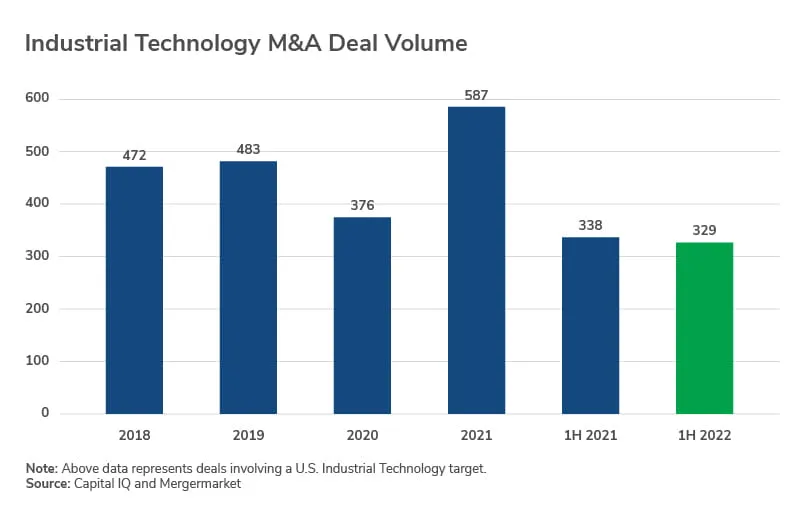
Year-to-date market performance has been driven primarily by multiple contraction whereas earnings expectations for the year have remained stable. Increasing uncertainty from a variety of sources has coincided with a slight decrease in the pace of deal making. The fundamental backdrop for the sector remains strong. Investors and corporate executives recognize the importance of investment in technologies to drive productivity growth. As OEMs have incorporated more intelligence into their products, they have been able to capture and monetize their customers’ operating data to deliver improved performance through offerings like condition monitoring and preventative maintenance, often sold as a service after the initial up-front product sale.
Corporates facing supply chain constraints, labor shortages and rising costs are increasingly implementing digital and physical automation tools to reduce manual processes and improve their focus on customers and vendors. Smart warehouse technologies increase the efficiency, accuracy, security and safety of material and supply handling, management, storage and distribution. These benefits underpin the projected ~8% CAGR in the global warehouse automation market, from ~$20 billion in 2021 to ~$40 billion in 2030.The importance of the technologies in stabilizing supply chains and the significant room for consolidation will continue to drive M&A opportunities for investors.
Read out Industrial Technology Industry Insights to learn more.
Kroll Corporate Finance and Restructuring is now on LinkedIn. Connect with us for the latest insights on investment banking, corporate finance, restructuring and insolvency solutions.
